
What Is Astrocartography? Lines, Meanings & How It Works
Oct 17, 2026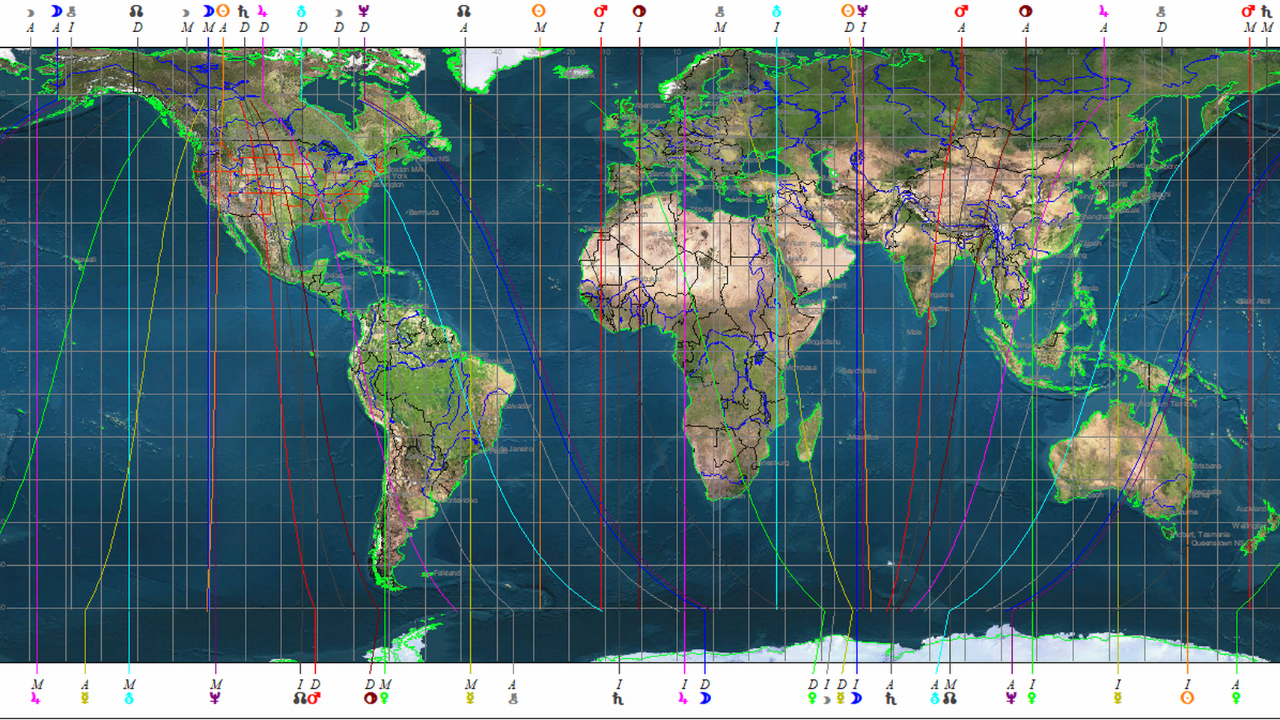
Have you ever traveled somewhere and immediately felt at home, even though you had never been there before? Or moved to a place where everything suddenly seemed more difficult, despite doing everything right?
Maybe you've noticed that certain cities bring out your confidence, while others seem to trigger emotional challenges, unexpected relationships, or major life changes.
Astrocartography offers an intriguing astrological perspective on these experiences.
It explores how different locations around the world connect with the patterns in your birth chart. And while traditional astrocartography focuses primarily on planetary lines, there are additional layers worth exploring: Chiron, the Lunar Nodes, Lilith, asteroids, and sensitive points.
At AstroNavigations, these factors are an integral part of my approach to understanding the relationship between people and places.
What Is Astrocartography?
Astrocartography, also known as locational astrology, is a branch of astrology that projects your birth chart onto a world map.
Using your exact birth date, time, and location, an astrocartography map illustrates where different celestial bodies were positioned on the four main angles of the chart at the moment of your birth.
In astrological interpretation, these locations may correspond with particular life themes, such as:
-
Career development and public recognition
-
Relationships and meaningful connections
-
Emotional security and a sense of belonging
-
Personal growth and transformation
-
Creativity, independence, and new opportunities
The central idea is that your birth chart remains the same, but different locations may emphasize different parts of its symbolism.
In other words, astrocartography explores not only who you are, but also where certain aspects of your potential may become more prominent.
How Do Astrocartography Lines Work?
An astrocartography map contains lines associated with celestial bodies and four important angles of the birth chart.
These angles are:
Ascendant (AC): Associated with identity, self-expression, personal development, and how you approach life.
Descendant (DC): Associated with partnerships, relationships, encounters, and the people who enter your life.
Midheaven (MC): Associated with career, public visibility, reputation, ambitions, and your direction in the world.
Imum Coeli (IC): Associated with home, family, emotional foundations, roots, and your private life.
For example, a Jupiter-Midheaven line is traditionally associated with themes of professional expansion, recognition, and opportunity.
A Venus-Descendant line may highlight relationship experiences, attraction, cooperation, or social connections.
However, a line should never be interpreted in isolation.
Its significance also depends on the individual's birth chart, planetary aspects, current life circumstances, and the wider astrological picture.
What Do the Different Planetary Lines Mean?
Each planet represents a different set of symbolic themes in astrology.
Sun Lines — Identity and Visibility
Sun lines are associated with confidence, vitality, self-expression, and recognition. They may symbolize places where questions of identity and personal direction become especially important.
Moon Lines — Emotions and Belonging
Moon lines emphasize emotional needs, family connections, intuition, and the desire to feel secure or at home.
Mercury Lines — Communication and Learning
Mercury lines are associated with networking, education, writing, business communication, intellectual activity, and the exchange of ideas.
Venus Lines — Relationships and Harmony
Venus lines traditionally symbolize attraction, relationships, creativity, aesthetics, and the desire for connection and pleasure.
Mars Lines — Action and Motivation
Mars lines are associated with initiative, ambition, courage, competition, and the need to assert yourself. They may also highlight themes involving conflict or impatience.
Jupiter Lines — Growth and Opportunity
Jupiter lines symbolize expansion, education, opportunity, optimism, and broader horizons. Their expression depends on the natal chart and the angle involved.
Saturn Lines — Responsibility and Structure
Saturn lines are associated with discipline, commitment, long-term development, boundaries, and the lessons that come through responsibility.
Uranus Lines — Freedom and Change
Uranus lines symbolize independence, unexpected developments, innovation, and breaking away from established patterns.
Neptune Lines — Inspiration and Idealism
Neptune lines are associated with imagination, spirituality, sensitivity, inspiration, and sometimes uncertainty or idealization.
Pluto Lines — Transformation and Power
Pluto lines symbolize deep psychological processes, questions of control, power dynamics, and profound personal transformation.
These meanings provide a starting point. A personalized interpretation requires much more than identifying a planet on a map.
Beyond the Planets: Chiron, the Lunar Nodes, and Lilith
Not every meaningful factor in an astrological chart is a planet.
Additional celestial bodies and calculated points can provide further symbolic perspectives on psychological patterns, personal development, karmic themes, and life experiences.
In my astrocartography work, I also consider Chiron, the Lunar Nodes, and Lilith.
Chiron Lines — Psychological Wounds and Integration
Chiron is a small Solar System body classified as a centaur, rather than a major planet.
In psychological astrology, Chiron is associated with vulnerability, deeply rooted wounds, healing, and the integration of difficult experiences.
Chiron lines may highlight locations where unresolved patterns, personal sensitivities, or important processes of self-understanding become more prominent.
Lunar Node Lines — Karma, Past Patterns, and Life Direction
The Lunar Nodes are calculated points where the Moon's orbital path intersects the ecliptic.
In karmic astrology, they are considered particularly significant because they symbolize the relationship between past experiences, deeply ingrained patterns, and the direction of personal and spiritual development.
North Node Lines — Karmic Growth and Soul Development
The North Node is traditionally associated with the soul's evolutionary direction, unfamiliar experiences, and qualities that an individual is encouraged to develop.
In karmic interpretations, North Node lines may symbolize locations where important encounters, life-changing experiences, or circumstances challenge someone to move beyond familiar patterns and explore new possibilities.
South Node Lines — Karmic Connections and Past-Life Themes
The South Node is associated with familiar behaviors, deeply rooted conditioning, and patterns that may feel instinctive or difficult to leave behind.
In karmic astrology, it is also connected with past-life symbolism, unresolved karmic themes, and relationships that may carry a strong sense of familiarity.
South Node lines may therefore be interpreted as locations where old emotional patterns, karmic connections, or recurring life lessons become especially noticeable.
Together, the Lunar Nodes form a symbolic axis between what feels familiar and what encourages further growth.
When examining astrocartography, I consider both nodes in relation to the entire birth chart, rather than interpreting either one as automatically positive or negative.
Lilith Lines — Autonomy and the Shadow Self
Lilith is a particularly fascinating factor in psychological astrology.
In this context, Lilith refers to Black Moon Lilith, a calculated point associated with the Moon's orbit, rather than a physical planet.
Lilith is often interpreted in connection with autonomy, suppressed desires, boundaries, rejection, and aspects of the personality that may be difficult to acknowledge or express.
Lilith lines may symbolically emphasize places where questions of personal freedom, authenticity, emotional intensity, or unconscious patterns become more noticeable.
As with all astrological factors, the interpretation depends on the entire birth chart and the specific angular line involved.
Beyond Planetary Lines: Sensitive Points in Astrocartography
This is where my approach at AstroNavigations becomes more specialized.
Most introductory explanations of astrocartography concentrate on the familiar planetary lines.
But in my work, I also incorporate sensitive points — mathematically calculated positions within an astrological chart that are interpreted as representing specific themes or areas of experience.
Depending on the astrological system used, these may include points associated with success, prosperity, relationships, personal challenges, or other specialized life themes.
These points can also be examined geographically, allowing additional lines and location-based patterns to be considered alongside the traditional planetary framework.
For example, when exploring professional opportunities, I may examine not only Jupiter or Sun lines but also relevant sensitive points connected with business success or wealth.
When examining relationships, sensitive points may provide another symbolic layer for understanding the themes that a particular location could emphasize.
These additional factors do not replace the birth chart or traditional planetary lines. They expand the interpretive framework.
This makes it possible to investigate a location from several astrological perspectives rather than relying on one prominent line.
The Role of Asteroids in Astrocartography
Asteroids represent another important dimension of my astrological work.
In psychological astrology, selected asteroids can be used to explore specific themes, including psychological complexes, relationship dynamics, internal conflicts, and recurring behavioral patterns.
For example:
Juno is associated with commitment, partnership expectations, and relationship agreements.
Ceres may reflect themes of nurturing, attachment, care, and emotional needs.
Pallas is connected with strategy, pattern recognition, and the ability to approach challenges from a different perspective.
Vesta is associated with dedication, focus, inner commitment, and the themes to which we devote our energy.
These are just a few examples. My work also incorporates other asteroids, including Eros, Pandora, and Toro, depending on the individual chart and the questions being explored.
When included in locational analysis, selected asteroids can also be mapped geographically, adding another layer of interpretation to the traditional planetary lines.
This is especially relevant when someone is exploring recurring psychological patterns or relationship experiences that cannot be adequately described by a single planetary line.
At AstroNavigations, I examine these influences alongside sensitive points and the broader birth chart to explore psychological patterns and location-related themes in greater depth.
Can Astrocartography Show You the Best Place to Live?
One of the most common questions people ask is:
Where should I move to be happier or more successful?
Astrocartography can help explore this question symbolically, but there is no single location that is automatically perfect for everyone.
A place associated with professional visibility may not necessarily correspond with emotional comfort.
A location emphasizing relationships may bring important encounters, but that does not guarantee an effortless partnership.
And a challenging planetary influence is not automatically a reason to avoid a particular city.
The more useful question is:
Which locations reflect the life themes, priorities, and experiences I want to explore at this stage of my life?
Someone seeking professional growth may prioritize different factors than someone looking for emotional stability, a fresh start, or a deeper understanding of relationship patterns.
This is why a meaningful astrocartography reading begins with the individual — not simply with the map.
Does Your Birth Time Matter?
Yes. An accurate birth time is particularly important in astrocartography.
Because the geographical placement of angular lines depends on the orientation of the birth chart, an inaccurate birth time can change where those lines appear.
For a personalized astrocartography analysis, your exact birth date, birth time, and birthplace are essential.
The more reliable the birth information, the more precisely the astrological map can be calculated.
Is Astrocartography Only About Moving Abroad?
Not at all.
You do not need to relocate permanently to explore astrocartography.
People may use it as a reflective tool when considering:
-
A temporary stay in another country
-
A career-related relocation
-
A new home or a change of environment
-
Travel destinations
-
Relationship experiences connected with particular places
-
Different cities or countries they are considering for the future
It can also offer a symbolic perspective on why certain places in your past felt significant.
However, astrology is an interpretive practice, not a scientifically established method for predicting outcomes. Decisions about relocation should also consider practical realities such as finances, employment, safety, legal requirements, and personal circumstances.
Why a Personalized Astrocartography Reading Goes Deeper Than an Online Map
An online astrocartography map can be a fascinating starting point.
But seeing a Jupiter, Venus, or Pluto line near a city is only one part of the analysis.
A personalized reading can bring together:
-
Your natal chart and its psychological themes
-
Planetary lines and their angular positions
-
Chiron, Lunar Node, and Lilith lines
-
Karmic themes and recurring patterns
-
Relevant aspects and interactions within the chart
-
Sensitive points connected with specific life themes
-
Selected asteroids and their psychological symbolism
-
Your personal questions, goals, and possible destinations
Rather than asking whether a location is simply good or bad, we explore what it may represent within your individual astrological framework.
This is the foundation of my approach at AstroNavigations.
Explore Your Personal Astrocartography Map
Your birth chart tells a story. Astrocartography explores how that story may connect with different places around the world.
And sometimes, the most interesting details are not found in the most obvious planetary lines.
By including Chiron, the Lunar Nodes, Lilith, sensitive points, and selected asteroids, I look beyond the standard astrocartography map to explore additional themes connected with career, relationships, karmic patterns, personal development, and psychological processes.
If you're considering a move, comparing destinations, or simply curious about the astrological symbolism of places that have shaped your life, my Horizon Navigation reading offers a personalized exploration of your geographical chart.
Discover your Horizon Navigation Reading at AstroNavigations.
AstroNavigations — Navigate Your Reality.